
Showing posts with label Chaucer. Show all posts
Showing posts with label Chaucer. Show all posts
Sunday, May 7, 2023

Friday, April 9, 2021
Monday, May 8, 2017
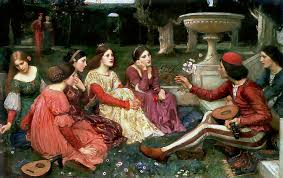
Chaucer and Boccaccio
CHAUCER and BOCCACCIO
CHAUCER probably read Boccaccio’s Decameron, Although
we have no proof of this.
Some
biographers think that Chaucer met Boccaccio in Florence, during a staying in
Italy in 1372.
There are
some similarities between the two works. However, there are some differences,
too.



DECAMERON The
CANTERBURY TALES
Completed around 1350 Completed between 1387 and 1395
NARRATORS NARRATORS
Seven
young women and three young men Thirty pilgrims, including Chaucer
They come
from the aristocracy They
come from different
social classes
They tell stories
in prose They
tell verse tales
During the Black Death (1348) In April
In a country house During their journey to Canterbury
To escape the plague To visit Thomas Becket’s shrine
100 stories 120
stories (only 24 completed)
Each member of the group
will tell a story each day for 10
days
DECAMERON
DECAMERON
 In general,
the storytellers choose a theme and
In general,
the storytellers choose a theme and all of them tell a story regarding that theme

The Canterbury Tales
Each pilgrim will tell two stories while going
to Canterbury and two stories while coming back from Canterbury
It’s told in a style of
language fitting the social class of the narrator
SIMILARITIES
Chaucer and Boccaccio implicitly criticize ecclesiastical
corruption and their treatment of women is similar.
Monday, April 24, 2017

Tuesday, April 18, 2017
Tuesday, April 11, 2017
THE MIDDLE AGES
THE MIDDLE
AGES
THERE WERE THREE LANGUAGES
FRENCH was used by the Norman nobles
(LAW;FOOD;ART;MEDICINE;LITERATURE)
LATIN was used by the CHURCH and as the language of
learning
MIDDLE ENGLISH (1100-1450) The language of COMMON PEOPLE
14th
century
THE GROWTH OF THE MIDDLE CLASS (NEW JOBS: shoemakers,carpenters,bakers,clothmakers,tradesmen)
They formed
a new URBAN MIDDLE CLASS
They were SKILLED ARTISANS
·
They
organized themselves into GUILDS ( da GELD-payment)
·
They
controlled the quality of goods
·
They
regulated prices and wages
·
They
held fairs
·
On
particular feast days, they performed scenes from the Bible
14th
century
THE GROWTH OF THE GENTRY(people of good social position, specifically the
class of people next below the nobility in position and birth)
A class of
landowners who was becoming rich
Wednesday, May 18, 2016
The Wife of Bath's tale -summary
Students in the third class have studied The Canterbury Tales by Chaucer.
In particular, they've focused on The Wife of Bath. They've read the description made by Chaucer in the General Prologue.
They've also read the tale told by her and they 've been asked to make a summary of it and build up five sentences about the text.
Here's one of the summaries with the questions:

Questions:
1. Why does Queen Guinevere punish the knight?
2. What is the punishment?
3. According to the hag, what do women most desire?
4. What does the hag want the knight to do for her?
5. At the end of the story, why does the hag decide to be
both beautiful and faithful?
Summary:
Queen Guinevere
punishes a knight for having rapen a maiden.
His punishment is to discover what women most desire.
After a year, the
knight hasn’t discovered yet what the Queen has asked him. When he goes to the
court again, he sees an ugly old hag, who tells him that she will give him the
answer if he grants her anything she wants.
The knight agrees.
The hag says that women want to have sovereignty over their husbands. Then, she
asks the Queen to force the knight to marry her.
They get married
but, on their wedding night, the knight doesn’t want to consummate the marriage
because his wife is horrible, old and low-class. Therefore, the hag starts a
speech about gentility, poverty and old age.
She offers the
knight a choice: either he can have her or he can have a beautiful but not
faithful wife. The knight turns the choice over his wife and she decides to be
both because he has yielded sovereignty to her. Finally, they live happily together.


During King Arthur’s age, in a land of fairies and
elves, there’s a young knight who one day sees a young woman walking along a
river and rapes her.
To punish him, queen Guinevere and her ladies decide
to make him find out women’s biggest desire and if he doesn’t, he’ll be
beheaded.
So he starts his search: he finds out lots of answers
but he can’t find two women who agree.
One year later he goes back to King’s Arthur’s court
without an answer, but on his way he meets 24 fairies who are dancing: they
disappear all of a sudden, to be replaced by an ugly old woman who accepts to
tell him what women most desire, but only on one condition.
He has to promise to please her. He accepts, so the
old lady tells him that women want to have control over their husbands.
After that, the hag wants him to fulfil his promise:
he has to marry her. But during the wedding night he doesn’t want to go on with
her because he thinks she’s ugly, old and poor.
The hag tells him to choose between an ugly but
faithful wife and a young but unfaithful one. He asks his wife to make a choice
and it means that he accepts to give his wife sovereignty over him.
That’s how he ends up having a beautiful and faithful
woman and living with her happily ever after.
QUESTIONS
Which punishment do the Queen and her ladies decide to
give the knight?
Who does the knight meet on his way to King’s Arthur’s
court?
What is women’s biggest desire?
What does the hag want the knight to do?
What choice does the knight make?

THEMES
- Sovereignty (Maistrie): The central theme concerning women's desire for control in marriage and over their own lives.
- Experience versus Authority: Alisoun's use of her lived experience to challenge traditional clerical authority and male-authored texts.
- True Nobility (Gentillesse): The argument that true nobility is a gift from God based on virtuous deeds rather than birthright.
- Justice and Transformation: The knight's journey from a criminal act to a restorative form of justice through education and his ultimate submission to his wife's will.
Tuesday, April 26, 2016
CHAUCER –an interview

This
morning I introduced Chaucer in an unusual way.
I didn’t
read his biography. I didn’t explain his life to the students. I didn’t choose
a video on youtube about him. I didn’t have them see some slides I could
find everywhere.
Instead I
decided that the best way was an interview.
I gave
three students some materials about Chaucer and I told another group of five
students to prepare some questions.
They had to
imagine to interview Chaucer’s “ghost”
about his life. The students having the information were asked to take
notes about the basic things on Chaucer’s life.
I asked the
students, who had to prepare the questions, “What would you like to know about
the author?”
The
students wrote down the following questions:
1. Which century did you live?
2. What was your social status?
3. Did you work? What job did you do?
4. What was your most important work?
5. Who were your works addressed to?
6. What themes did you deal with in
your works?
7. When did you die?
One of the
students answered the questions, using the first singular person and adding
some more information on the basis of his information.
Another
student told about Chaucer’s life using the third singular person.
I think it
was a good exercise to ask questions and give answers using the Past Simple and the
first and the third singular person.

Subscribe to:
Posts (Atom)