Hello! My name's Liliana. I'm a teacher of English (Language and Literature) to Italian teenage stu

Tuesday, October 3, 2017

THE VICTORIAN AGE


QUEEN VICTORIA


Victoria (1819-1901) was queen of the United Kingdom of Great Britain and Ireland (1837–1901) and empress of India (1876–1901). She was the last of the House of Hanover and gave her name to an era, the Victorian Age.  She and her husband, Prince Consort Albert of Saxe-Coburg-Gotha, had nine children.

Her reign saw advances in industry, science (Darwin’s theory of evolution), communications (the telegraph, popular press), and other forms of technology; the building of the railways and the London Underground, sewers, and power distribution networks;  a greatly expanded empire; unequal growth of wealth, with class differences; tremendous poverty; increase in urban populations, with the growth of great cities like Manchester, Leeds, and Birmingham; increased literacy; and great civic works, often funded by industrial philanthropists.

Here is a video about Queen Victoria (first part)

https://youtu.be/wEOtVXydiEI


http://www.iispandinipiazza.gov.it/wp/wp-content/uploads/2016/06/The-Victorian-Age-1.pdf


Tuesday, September 19, 2017

Wordsworth’s Life Lessons: Splendour in the Grass
William Wordsworth’s Ode to Intimations of Immortality is the classic example of the beauty of the mind, and the complexity of the values of innocence and experience.
The key passage from this Ode, is the following. It is so profound that it inspired the movie Splendor in the Grass with Warren Beatty and Natalie Wood(1961)


“What though the radiance which was once so bright
Be now for ever taken from my sight,
Though nothing can bring back the hour
Of splendour in the grass, of glory in the flower;
We will grieve not, rather find 

Strength in what remains behind;
In the primal sympathy
Which having been must ever be;
In the soothing thoughts that spring
Out of human suffering;
In the faith that looks through death,
In years that bring the philosophic mind.”


 William Wordsworth

Benché la radiosità
un tempo così luminosa
sia adesso tolta per sempre dai miei occhi,
benché nulla possa portare indietro l'ora
di splendore nell'erba,
di gloria nel fiore,
noi non ce ne dorremo, piuttosto troveremo
forza in quel che resta dietro;
nell'affinità primaria
che essendo stata per sempre deve essere;
nei pensieri docili che sgorgano
dall'umano soffrire;
nella fede che vede attraverso la morte,
negli anni che portano la mente filosofica


LEOPARDI and WORDSWORTH
SIMILARITIES

  • Importance given to emotions and feelings
  • Focus on nature in his poems
  • they believe in the existence of different phases in human life
  • Youth is the age of hopes and illusions
  • poetry as a creative activity is the product of recollections ' in a state of tranquility'
  • they have a tendency to personify the elements of nature (the moon, the rainbow, the daffodils)
  • they are aware of what is painful to live 

DIFFERENCES
LEOPARDI

  • in Leopardi's view, nature is evil, blasting and indifferent to the man  
  • he doesn't believe in any possibility of comfort or solace
  • he rejects the idea of life after the earthly one
  • life is a sequence of painful moments 

WORDSWORTH

  • nature is a moral guide
  • it gives joy and relief
  • it has a comforting function
  • it's a haven from the horrors of the Industrial Revolution
  • he believes in 'Intimations of immortality'
  • before the birth the soul pre-existed in heaven and the child is in a state of innocence and purity because he is still close to God.
  • he is able to recall the heavenly state of his soul
  • through his imagination and the close contact with nature, the poet may recall that condition, as well
La ginestra
it's an example of solidarity and solace in the desert of life 

Daffodils
they're an example of joy and comfort for the man. It's a vital force, a direct expression of the presence of God


Natalie Wood - "Splendor in the Grass"

Sunday, September 17, 2017

ASSIMILATION (T) before P

ASSIMILATION (T)before  P
It's a white piece of paper.

In fluent speech, if one word ends in a /t/ sound and the next word begins in a /p/ sound, the /t/ is pronounced slightly differently. In fact, we pronounce it as if it were almost a /p/ sound. So 'white piece of paper' becomes 'whi(te) piece of paper'.
This is an example of how sounds change in everyday speech - and it's called
assimilation. Here are some more examples:
Examples
There are lots of grea(t) parks in London.
I love spli(t) pea soup.
I ha(te) potatoes.
My ma(te) picked us up from the airport.

split personality
sweet potato
test paper
private practice

secret police

Two short videos about Elizabeth 1 and William Shakespeare

http://learnenglishkids.britishcouncil.org/en/short-stories/elizabeth-i


http://learnenglishkids.britishcouncil.org/en/short-stories/william-shakespeare


Monday, September 11, 2017

Back to school second written test English Liceo Linguistico


This is the actiity for the next time.
Practice with the second written test
 Sessione ordinaria 2017
Seconda prova scritta
Ministero dell’Istruzione, dell’ Università e della Ricerca
PL01 – ESAME DI STATO DI ISTRUZIONE SECONDARIA SUPERIORE
Indirizzi: LI04, EA03 - LICEO LINGUISTICO
Tema di: LINGUA STRANIERA - INGLESE
A - ATTUALITÀ
Poverty Affects Education—And Our Systems Perpetuate It
It’s hard to argue that poverty does not affect education. It’s hard to argue that children who come from homes where they may be wanting—wanting for food, for time, or for resources—don’t enter the school door with a little less than others. And it’s hard to argue that children living in poverty and attending schools that are underfunded, underresourced, and understaffed are not literally up against the system.
We have established a system where those who are poor are more likely  to stay poor, and lately we have seen a sharp increase in those considered poor. In fact, a recent research bulletin from the Southern Education Foundation highlights that, as of this year, the majority of public school children come from poverty. According to the bulletin, “The latest data collected from the states by the National Center for Education Statistics (NCES), show that 51 percent of the students across the nation’s public schools were  low income in 2013”.
In 40 of the 50 states, low income students comprised no less than 40% of all public schoolchildren. In 21 states, children eligible for free or reduced-price lunches were a majority of the students in 2013.
51 percent of our children across the country now live in poverty, and the numbers appear to be growing. 51 percent.
Coincidentally, it has also been 51 years since we, as a nation, declared poverty unacceptable. It has been 51 years since President Lyndon B. Johnson launched the War on Poverty in his 1964 State of the Union Address.
This administration today, here and now, declares unconditional war on poverty in America. I urge this Congress and all Americans to join with me in that effort. It will not be a short or easy struggle, no single weapon or strategy will suffice, but we shall not rest until that war is won. The richest Nation on earth can afford to win it. We cannot afford to lose it. One thousand dollars invested in salvaging an unemployable youth today can return $40,000 or more in his lifetime.
During this address, Johnson also acknowledged that “many Americans live on the outskirts of hope— some because of their poverty, and some because of their color, and all too many because of both.”
Poverty, Johnson said, was a “national problem,” one that required a collective response across all levels of government and society. His address singled out every American to do his part.
Fifty-one years later, however, we have established systems that perpetuate and even accentuate poverty.
Schools in low socioeconomic areas are underfunded when compared to higher socioeconomic
neighborhoods. They tackle chronic issues with a chronic lack of resources. While those who work in these schools may be passionate, hard-working, and motivated educators, they frequently lack experience, support services, and political power.
Thus, the message becomes clear—if you are born into poverty, you are likely to stay in poverty.
As a country, we have deep-rooted negative stereotypes about people living in poverty, despite the fact that people who live in poverty are as diverse in their norms, beliefs, and behaviors as people who live in any other socioeconomic stratum. Poverty spans geographical and ethnic boundaries, from urban cities to rural towns. There are many communities that have battled poverty for decades and many where poverty has arrived recently, unexpectedly, and in a rush.
Poverty is neither fair nor equitable, and it is not productive for society. If we ignore, as Charles Blow
 called it, the “corrosive effects of poverty” on our nation’s children, it will come back to haunt us. And as Steve Suitts, author of the Southern Education Foundation research bulletin, said, “It’s a matter of our national future, because when one group becomes the majority of our students, they define what that future is going to be in education more than any other group.”
So what do we do? Rather than just get angry, we must get active.
 We can and should commit to addressing poverty via intersectoral alignment, change the formula by
which we fund our schools, and ensure that inequities are at the heart of all policy discussions. […]
Poverty affects our education, our economy, and our future. It is becoming the norm, and we appear
reluctant to address it. What was once a local, regional, or state concern is now a national issue and will affect our national progress. But we have the steps in place to change it—and we’ve had these steps for over half a century. What has been waning is our will to act and our determination to succeed. […]
[769 words]
From: Stephen Slade, “Poverty Affects Education—And our Systems Perpetrate It”,
The Huffington Post (US edition), 24 April 2015.
Available online: http://www.huffingtonpost.com/sean-slade/poverty-affects-education_b_7861778.html
Accessed on 20 January 2017.
COMPREHENSION AND INTERPRETATION
Answer the following questions. Use complete sentences and your own words.
1. According to the author, in what ways do poor children “enter the school door with a little less than
others”?
2. What alarming fact regarding the children in the USA’s public schools is highlighted by NCES data?
3. How do you know from the article that poverty among children has become a wide-spread
phenomenon in the USA? State at least 2 facts.
4. Name at least 2 points that President Lyndon B. Johnson made in his speech to argue for the urgency
to fight poverty.
5. What relationship does the author establish between poverty and the education system in the USA?
6. Why is poverty depicted in the article as a trap out of which it is difficult for people to escape? Give 2 reasons.
7. Where can poverty be found?
8. What group is Steve Suitts referring to as having become “the majority of our students”?
9. Name two ways in which it might be possible to address poverty according to the author.
10. Why does the author believe the issue of poverty has not been addressed in the last 50 years?
PRODUCTION
Choose one of the following questions.
Number your answer clearly to show which question you have attempted.
Either
1. The European Parliament resolution of 24 November 2015 on reducing inequalities with a special
focus on child poverty (2014/2237(INI)) recalls that “child poverty is a multi-dimensional
phenomenon that requires a multi-dimensional response” and that “tackling child poverty requires the
adoption of a life-cycle approach […] that reflects the different needs of early childhood, primary
childhood and adolescence”.
In an essay of approximately 300 words, show your own personal understanding of what a “multidimensional response” and a “life-cycle approach” to tackling child poverty might entail. Think alsoabout what you have read in the article.
Or
2. Imagine that you and your volunteer group have been awarded a grant of 10 thousand Euro to set up a local community project to help at-risk teenagers in your neighbourhood stay in school and succeed in their education. Write a composition of about 300 words to describe the specific situation you would like to address, what you would do to address it and who you would involve. Try to make your project credible, also by considering the amount of money you have for it.
__________________________
Durata massima della prova: 6 ore.
È consentito soltanto l’uso dei dizionari monolingue e bilingue.
Non è consentito lasciare l’Istituto prima che siano trascorse 3 ore dalla dettatura del tema.

Wednesday, May 31, 2017

A short essay-an example

SHOULD TEENAGERS HAVE A PART TIME JOB?

During adolescence, every person starts to feel the need to become independent and scrape some money at the same time.

Some teens want to help their families, others want to experience a working environment, but most of them want to earn some money to buy something or travel.

So, the reasons why teenagers want to work are different.It isn’t always easy for teens to get a job, because employers are really demanding and prefer employing people who have already experienced working before.

Surely, the benefits are more numerous than the drawbacks.

First of all, working gives confidence, sense of responsibility and independence in teens’ minds.Indeed, they understand what it means to earn money by sacrifice and they learn how to manage finances.

Furthermore, it’s useful to get marketable skills and to obtain valuable work experience.

The few drawbacks are related to the fact that working could interfere with teens’ studies, because working students may not have time to finish their homework.

What’s more, it could increase stress and tiredness and not everyone is able to balance work and school.

In my opinion summer employment is a good alternative, because teenagers take advantage of their spare time and it doesn’t interfere with their studies.

On the whole, teenagers should  have a part-time job, even if it is only a way to use up their time

Tuesday, May 30, 2017

Your room


MY ROOM 


My room
In my room there are two beds because I share it with my sister.
The walls are pink and violet, the colour of the ceiling is white.
The room is very big.
I have a huge wardrobe and a small desk with some books and dictionaries. The curtains are striped. They are pink and white.
In  my bedroom I mostly sleep but I also do other things. I stay in my bed all day with my mobile when I am bored or tired. In my bedroom I do my homework on my desk and I sometimes read some books. In the morning before going to school I get dresses in my room only if there’s someone in the bathroom.
My room is a  good place because it is very quiet.


My room
My bedroom is for me the most important room in the house. Here I feel relaxed because I am often alone and I can think, listen to music and do my homework quietly
In my room there are too many things, but the most important for me is my bed, because it is very comfortable.
My bedroom is very small but it is nice. The walls are of my favourite colours-green and yellow.
On the walls there are a lot of photos about me and my sister when we were children and some drawings made by me.
I love my bedroom and I don’t change it for nothing in the world.


My room
In my room I have got a lot of furniture.
When you enter my room you can see on the right and on the left two bookcases. One is used to put my school books and the other one for the books that I like reading in my free time.
There are two wardrobes and there is my desk, where I do my homework.
Behind there is my bed. Opposite the door there is a balcony. The colours of my room are white and black with some shelves, which are gray.
I love my room. I do lots of things there.


My room
 My room is the place where I spend a lot of my free time. Some years ago I didn’t like my room but then I changed the furniture and now I really love it. It has got pink and green walls, a white and grren wardrobe that is too big to keep my few clothes (actually it isn’t full enough).
Then there is a bedside table and a bedroom with a light pink duvet. My favourite furniture is the bookcase where I keep my school books, the copybooks, books to read, photos and a stereo.
But the desk is the most useful furniture, because I can do my homework there and I always see films and TV series from my computer. My room is very sunny, because there is a balcony with pink curtains, where I can see the countryside from. In addition, in my room I always listen to music, I get dressed and sometimes I spend time with my friends. I think that a bedroom is just a room but it’s even a place where you can seek refuge when you are sad.


Monday, May 8, 2017

Chaucer and Boccaccio

CHAUCER and BOCCACCIO

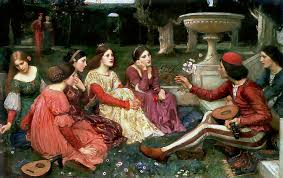
CHAUCER probably read Boccaccio’s Decameron, Although we have no proof of this.
Some biographers think that Chaucer met Boccaccio in Florence, during a staying in Italy in 1372.
There are some similarities between the two works. However, there are some differences, too.


DECAMERON                                        The CANTERBURY TALES
Completed around 1350                                                 Completed between 1387 and 1395

NARRATORS                                                                  NARRATORS
Seven young women and three young men                    Thirty pilgrims, including Chaucer
They come from the aristocracy                                     They come from different social classes

They tell stories in prose                                                  They tell verse tales

During the Black Death (1348)                                                                  In April

In a country house                                                                 During their journey to Canterbury
To escape the plague                                                               To visit Thomas Becket’s shrine

100 stories                                                                             120 stories (only 24 completed)


Each member of the group                              
will tell a story each day for 10 days                                                                                                           
DECAMERON              

In general, the storytellers choose a theme and   
all of them tell a story regarding that theme


                                                                            The Canterbury Tales
          
Each pilgrim will tell two stories while going 
to Canterbury and two stories while coming back from Canterbury 


                           Each tale reflects the personality of the  pilgrim telling it
It’s told in a style of language fitting the social class of the narrator

SIMILARITIES


Chaucer and Boccaccio implicitly criticize ecclesiastical corruption and their treatment of women is similar.

Thursday, May 4, 2017

Colonialism and imperialism


MUST-MUSTN'T/SHOULD-SHOULDN'T
Students have written down their classroom rules........


Classroom rules


·       Students mustn’t shout
·       Students should pay attention

·       Students shouldn’t chat
·       Students mustn’t use their mobiles
·       Students should be honest

·       Students have to do their exercises
·       Students mustn’t sleep in the classroom
·       Students shouldn’t smoke in the school
·       Students have to follow the lesson
·       Students should be positive and creative

·       Students shouldn’t drop things on the floor
·       Students mustn’t steal things
·       Students shouldn’t copy from classmates,  especially during their written tests

·       Students should follow rules
·       Students should wear appropriate clothes for school

·       Students mustn’t eat during the lessons